Past papers are the best practice there is for an exam, so two questions come up every year: when should I start them, and will I run out? The short answers: start once you have covered enough of the course, and no later than when you have finished it. And no, you almost certainly won't run out.
- You did a past paper early and the score knocked your confidence
- You are worried you will run out of papers before the exam
- You mark your own papers, and the scores look better than your mocks
This guide covers when full papers start to help, how many there really are and which order to do them in, and how to mark them so the score means something.
Why not start them straight away?
Because a paper done too early teaches you much less than it seems to.
If past papers are the best practice, it's tempting to start them as early as you can. But a past paper is written to test content you already know reasonably well. If you start one before you do, one of two things tends to happen, and neither is real progress.
Exam questions are not designed to teach. They are designed to assess.
There is a cost to confidence as well. A full paper attempted before you are ready means question after question you cannot do yet, and that tends to put students off papers just when they need them most.
When to start
Between having covered enough of the course and having finished it.
Plenty of students leave past papers too late, so this is about finding the sweet spot rather than holding off. You want to have covered enough content for a paper to be a fair test, and for most students the latest to start full papers is when you have finished all the course content. If you have, early April is a good time to be starting.
You don't have to wait for everything, either. If your school finishes the pure content before the statistics and mechanics, you can start the pure papers then. The papers from one exam series don't have to be done together: do the pure papers when you are ready for them, and the applied ones when you have finished those topics.
- Year 12 and early Year 13Mixed exam questions, and AS papersA regular mixed set of exam questions on the topics you have finished. AS papers count here too, and in early Year 13 as well (more on that below).
- As each part of the course is finishedThat part's papersFinished the pure content? Start the pure papers, timed, while you are still finishing the statistics and mechanics.
- By early April, if the content is doneFull papers in exam conditionsWhole papers against the clock, each marked properly and its mistakes followed up.
- The last monthAbout three papers a weekBy now the content should be secure, and the papers are for technique, timing and finding where marks are still being lost.
When your school finishes the course matters, and it varies a lot. If you are doing mixed exam questions regularly through the year, starting full papers a bit later is not a big deal. But give yourself plenty of time, for two reasons: to practise in exam conditions, and to find out which topics you still need to work on while there is time to work on them.
Will you run out?
Almost certainly not, but there is a catch worth knowing about.
There are more A Level Maths papers than most students expect. For each board:
The most diligent students might get through all of them, but most won't. The catch is a different one. If you have been doing exam questions all through the year, as you should, you will already have seen a fair few of the questions on the papers. That makes a past paper less useful for the thing you want it for in the last few months: finding out where you actually are now.
So it is worth thinking about the order you do them in.
Your board's latest papers are the most like the one you will sit, so leave them until closer to the exam. For the older ones, the order doesn't matter much.
Each board has several mock papers and sample papers alongside the real ones. They are full papers in the right format, and good ones to use earlier.
The content is about 90 to 95% the same across boards, so if you ever did run short, there are plenty of papers from the other boards to have a go at.
Every board's papers, with mark schemes and examiner's reports, are on our past papers page.
Mark it like an examiner
Because a generous score hides exactly what you need to fix.
When students send me papers they have marked themselves, I nearly always find a substantial number of marks they have given themselves that they would not have got in the exam. Here is how that happens, on one exam-style question and one of the most common ways to lose a mark.
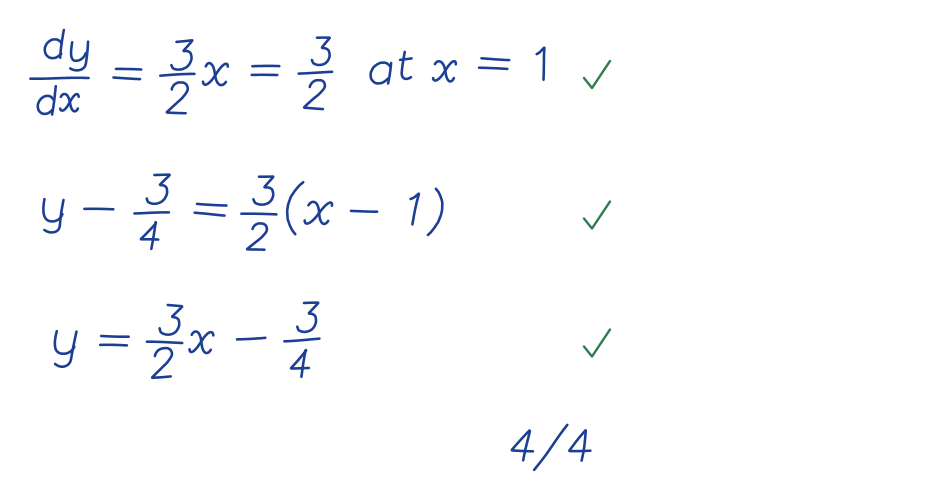
Every line ticked: 4 out of 4.The mark scheme's line was the same line, so it looked right.
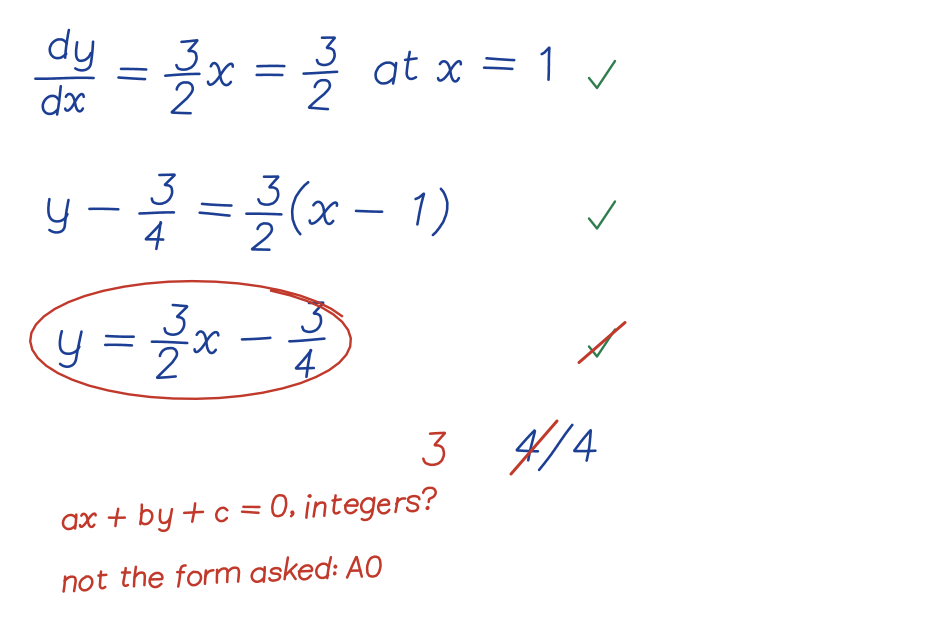
The last mark goes: 3 out of 4.An example of how the marks might be split. The last one is for the answer in the form the question asked for.
The mark scheme's answer was 6x − 4y − 3 = 0. The student saw it was the same line as theirs and ticked it. But the question asked for that form, with integers, and the last mark is for getting there. Examiners' reports regularly mention this one. When you mark your own paper, check each answer against what the question asked for, not just against the number in the mark scheme. Those are exactly the marks a generous self-marker gives away.
Where we fit in
A free account gives you past papers for every board, with mark schemes and examiner's reports, exam questions by topic, and flashcards for the key facts and formulae, so a question you can't start is never just a formula you can't remember. Premium membership adds live online lessons, recorded, plus predicted papers. See what each includes.
If you would like someone to mark your papers properly and work on what they show, The A Level Maths Tutor offers 1-1 tuition online and small Exam Practice groups.
Got a question this didn't answer?
Ask me directly and I'll reply by email. The questions students ask most are how these guides get written.

Written by
Andy Parker, Lead Tutor
I run A Level Maths Academy and The A Level Maths Tutor, and teach the course every week. These guides come from the questions students actually ask me, usually more than once. More about me.
Live lessons
Want this taught, not just read?
Premium membership adds live online lessons through the course, recorded so you can catch up, with predicted papers to practise on. A free account gets you past papers with their mark schemes, and exam questions by topic.
See what membership includesRead next
Edexcel Maths: "You Must Show All Stages of Your Working"
Edexcel uses two versions of this instruction and they differ by one word. If you misread which one you've got, a correct answer can score nothing.
OCR and MEI Maths: What "You Must Show Detailed Reasoning" Means
On a detailed reasoning question the right answer on its own can score nothing. This is what OCR and MEI mark schemes look for, and the habit that tends to lose the most marks.
AQA Maths: What "Fully Justify Your Answer" Actually Means
The phrase means some of the marks are for explaining rather than calculating, and you can lose them with a correct answer. This is what AQA's examiners accept.